
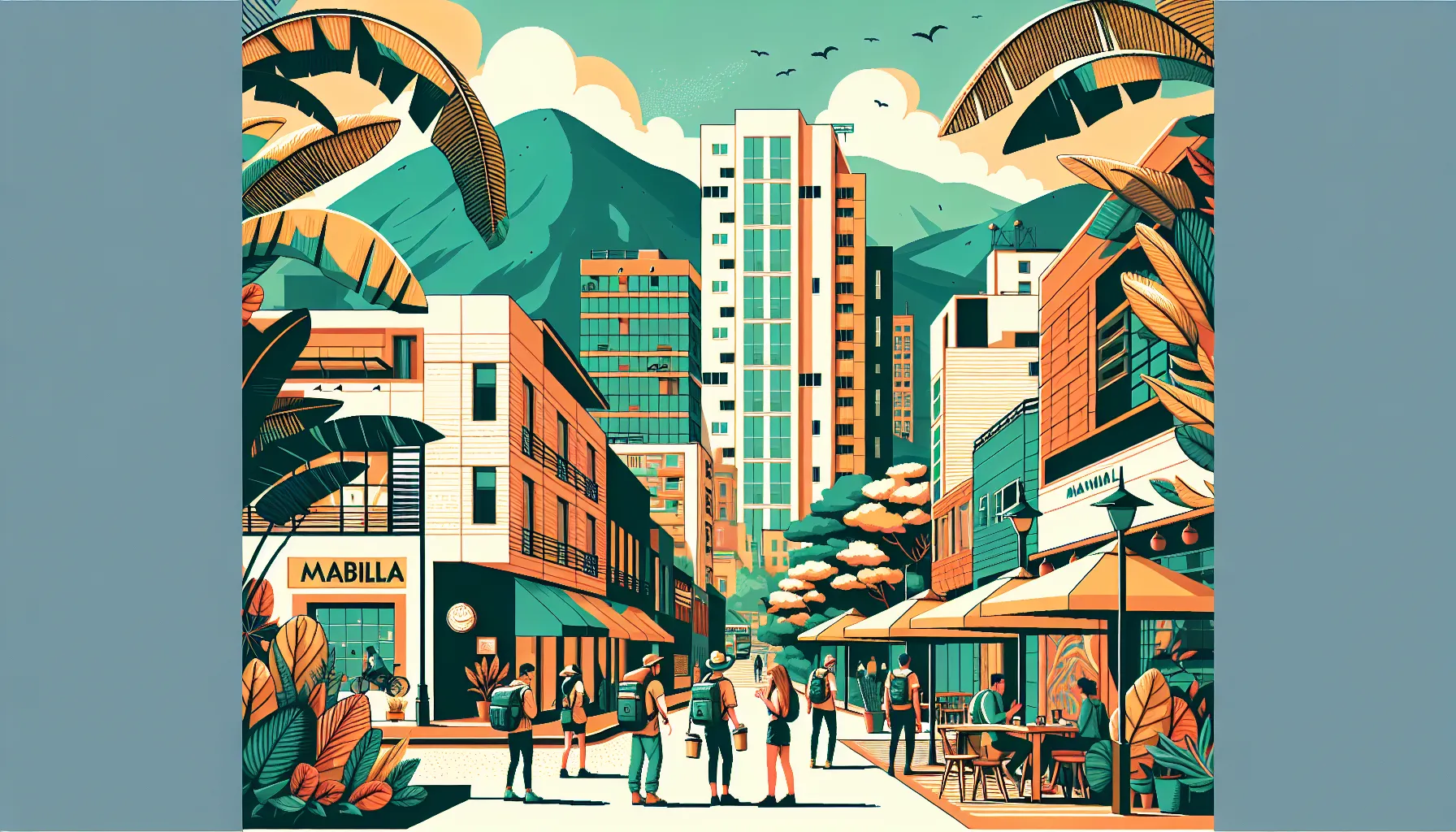
Manila, El Poblado: Medellín’s Low-Rise Neighbourhood
Manila is a small barrio in El Poblado, a short walk from Provenza but out of its noise. It has kept low buildings, brick facades and street trees where the rest of El Poblado went vertical, which is the whole reason to stay here.
The history, accurately
This part is usually told wrongly, and the true version is more interesting.
El Poblado began on 2 March 1616 as San Lorenzo de Aburrá, founded by Francisco de Herrera Campuzano, oidor of the Royal Audience and Visitor of the Province of Antioquia (Vivir en El Poblado).
It was not a settlement of Spanish colonists. It was established as an indigenous resguardo — a reservation created under the Leyes de Indias, explicitly to protect indigenous people from mistreatment by Spanish settlers. It began with 80 indigenous inhabitants, on the site of what is now El Poblado’s main park. The wider valley was home to the Yamesíes, Niquías, Nutabes and Aburraes, numbering around 300 people (Albicentenario).
In 1646 San Lorenzo was relocated to the site of Aná — today’s downtown Medellín. The original settlement declined under racial segregation laws and poor conditions, and the indigenous population had largely dispersed by that year.
El Poblado then spent the 18th and 19th centuries as farmland and coffee estates on the city’s outskirts, which is why its urbanisation is so recent and why Manila’s low-rise streets read as old by local standards.
Where things are
| Place | Type | Address |
|---|---|---|
| Los Patios Hostel | Hostel with rooftop | Carrera 43E #11-40 |
| Cambria Café Resto | Bakery-pâtisserie and restaurant-bar | Carrera 43E #12-16 |
| Rango Boutique Hostel | Hostel; Bread Factory bakery inside | Calle 8 #42-25 |
Los Patios sits on Carrera 43E in Manila, a 10-minute walk from Poblado metro station and within walking distance of Parque Lleras (Los Patios).
Cambria opens at 7:30 AM on weekdays and 8:00 AM on Saturdays, closing at 8:00 PM Monday to Wednesday, 9:30 PM Thursday and 11:00 PM Friday and Saturday (Degusta).
Rango houses the Bread Factory bakery at Calle 8 #42-25 — worth knowing, because that bakery is often listed as a separate destination (Degusta).
Cafés and eating
Manila’s café strip is the reason digital nomads pick it over Provenza:
- Hija Mía Coffee Roasters — breakfast and coffee
- Cambria Café Resto — bakery-pâtisserie in a 1920s room
- Ganso & Castor — breakfast, coffee and brunch
- La Pequeña Gran Librería — a café-bar with board games on outdoor tables
For food, the neighbourhood runs broader than most of El Poblado: Halong Vietnamita (Vietnamese), Hacienda Manila (traditional Colombian), El Altar Taquería, Lavocadería, Mamasita Medallo, Bao Bei (Asian, reservations advisable) and plant-based Vegan & Veggie.
Café Zorba, the well-known pizzeria, is also in Manila — not in Provenza or on the Milla de Oro, where guides routinely place it.
Nightlife
Manila’s bars are quieter than Provenza’s by design:
- Siete Pulgadas Listening Bar — vinyl and cocktails
- Alambique Laboratorio Cocina & Bar — a third-floor bar in a gallery building by Parque El Poblado
- Foxy Pub — craft beer across two floors
For a full night out, Provenza and Parque Lleras are a short walk away. Since April 2024, municipal decrees restrict solicitation in public space across Parque Lleras, Provenza, Calle 10 and Parque El Poblado, and a pilot caps alcohol venues there at 1:00 AM (Alcaldía de Medellín).
Getting around
Poblado station on Line A is a 10-minute walk, connecting to the centre, Envigado and Sabaneta. Fares from 10 January 2026: 3,820 COP Cívica Frecuente, 4,400 COP Eventual/tourist (Metro de Medellín tariffs).
At night, use a booked ride rather than a street taxi.
A note on this guide
Rechecked in September 2026. The history section was corrected: San Lorenzo de Aburrá was founded on 2 March 1616 as an indigenous resguardo under the Leyes de Indias, with 80 indigenous inhabitants — not, as the article had it, a colonial settlement “home to a mix of Spanish settlers and Indigenous peoples”. The relocation is dated to 1646. Addresses were added, a broken **Cambri**a** bold tag and an empty entry for Alambique were fixed, and unsourced claims — that buildings are “no taller than four stories”, that a “large police station” underpins the neighbourhood’s safety, and that Manila is “one of the safest neighborhoods in Medellín” — were removed.