
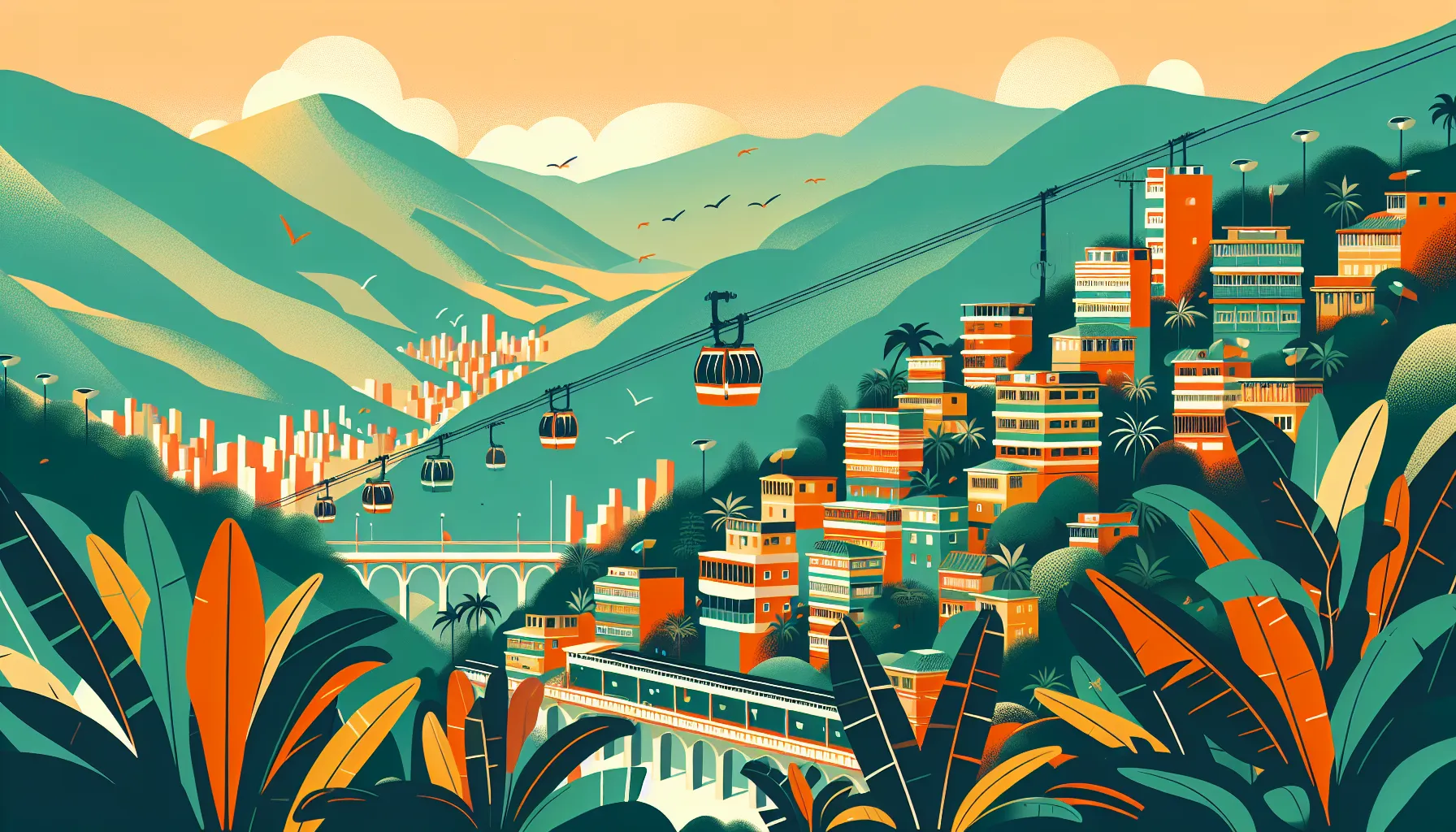
Medellín’s Metrocable: How Cable Cars Connected a Divided City
If you’ve ever taken Medellín’s Metro and watched the cable car gondolas glide silently up the steep green hillsides, you’ve witnessed one of the most important urban transit experiments of the 21st century. The Metrocable isn’t just a way to get around — it’s the physical infrastructure of social inclusion.
A City Split by Geography
Medellín sits in the narrow Aburrá Valley, hemmed in by mountains on all sides. For decades, the wealthiest neighborhoods occupied the flat valley floor while hundreds of thousands of lower-income residents built homes on the steep hillsides above. The physical distance was short — a couple of kilometers — but the commute could take well over an hour each way on crowded, winding buses. That travel time wasn’t just inconvenient; it locked people out of jobs, education, and city life.
Line K: The First Cable Car in Public Transit History
When Line K opened in 2004, connecting the hillside barrios of Santo Domingo and Popular to the Acevedo Metro station, it was the first aerial cable car system in the world designed as formal mass transit rather than a tourist attraction. A journey that previously took over an hour was cut to roughly 15 minutes.
The impact was immediate and measurable. A study published in the Journal of Transport Geography found that job accessibility in the Metrocable corridor doubled in five years — from 0.33 to 0.62 jobs per working-age individual. Residents could suddenly reach hospitals, universities, and employment centers that had been effectively unreachable before.
More Than Transportation
What makes the Metrocable remarkable is that it was never conceived as just a transit project. Under Mayor Sergio Fajardo’s administration (2004–2007), the cable car was part of a broader strategy called Social Urbanism — the idea that public investment should flow first to the most marginalized areas.
Alongside the cable lines, the city built library parks, schools, public plazas, and sports facilities in the same hillside neighborhoods. A landmark epidemiological study published in the American Journal of Epidemiology found that in neighborhoods served by the Metrocable and its companion projects, the homicide rate declined 66% more than in comparable control neighborhoods. Resident reports of violence decreased by 75%.
Research from Springer’s Urban Transformations journal argues that the Metrocable’s deepest impact was psychological: residents reported feeling included in the city for the first time. The cable car became a symbol that the government acknowledged their existence.
The Network Today
Since Line K, the system has expanded significantly:
- Line J (2008) — Connects San Javier to La Aurora in the western hills
- Line H (2016) — Serves Comuna 13, linking to the famous outdoor escalators
- Line M (2019) — Extends from Miraflores to Trece de Noviembre
- Line P (2022) — Connects the Metro to the Arví Ecological Park in the eastern mountains
Each new line has followed the same formula: cable infrastructure paired with social investment in the surrounding neighborhoods. Studies show that newly connected neighborhoods consistently experience urban renewal, with local businesses settling in and crime rates decreasing.
Riding the Metrocable as a Visitor
For visitors, the Metrocable is one of Medellín’s essential experiences — and it costs the same as a regular Metro ride (about 3,100 COP / less than $1 USD with a Cívica card).
Line K to Santo Domingo is the most popular route for tourists. From the Acevedo station, you’ll glide over the densely packed hillside barrios with panoramic views of the entire valley. At the top, you can visit the Parque Biblioteca España (currently under renovation) and the Santo Domingo park.
Line L to Parque Arví takes you from the Santo Domingo station up and over the mountain ridge into a 16,000-hectare ecological reserve — a completely different world of cloud forest, hiking trails, and weekend markets, all reachable in 20 minutes from the Metro.
Line J passes over Comuna 13, giving you aerial views of the famous graffiti murals before you descend to explore on foot.
A Global Model
Medellín’s Metrocable has been studied and replicated across the world. Cities including La Paz (Bolivia), Caracas (Venezuela), Rio de Janeiro (Brazil), and Algiers (Algeria) have built their own urban cable car systems, all citing Medellín as the proof of concept.
A comprehensive review in Transport Reviews (2023) found that while cable cars alone don’t solve poverty — complementary social projects are essential — the travel time and cost reductions they provide meaningfully increase accessibility for residents who need it most.
The Metrocable is more than a ride. It’s a thesis statement: that a city’s most powerful infrastructure isn’t highways or airports, but the connections it builds between its own people.
References:
-
Bocarejo, J.P. et al. (2014). “An innovative transit system and its impact on low income users: the case of the Metrocable in Medellín.” Journal of Transport Geography, Vol. 39, pp. 49–61. ScienceDirect
-
Brand, P. & Davila, J. (2011). “Mobility innovation at the urban margins: Medellín’s Metrocables.” City, Vol. 15, No. 6, pp. 647–661. Taylor & Francis
-
Galvin & Maassen (2020). “Connecting formal and informal spaces: a long-term and multi-level view of Medellín’s Metrocable.” Urban Transformations, Springer Nature. Springer
-
Cerdá, M. et al. (2012). “Reducing Violence by Transforming Neighborhoods: A Natural Experiment in Medellín, Colombia.” American Journal of Epidemiology, Vol. 175, No. 10, pp. 1045–1053. Oxford Academic
-
(2023). “Aerial cable cars as a transit mode: a review.” Transport Reviews, Taylor & Francis. Taylor & Francis
-
Davila, J. (ed.) (2013). “Urban Mobility and Poverty: Lessons from Medellín and Soacha, Colombia.” Development Planning Unit, UCL. UCL Bartlett DPU
-
(2020). “Impact of aerial cable car in low-income area in Medellín.” Transportation Research Procedia, Elsevier. ScienceDirect